
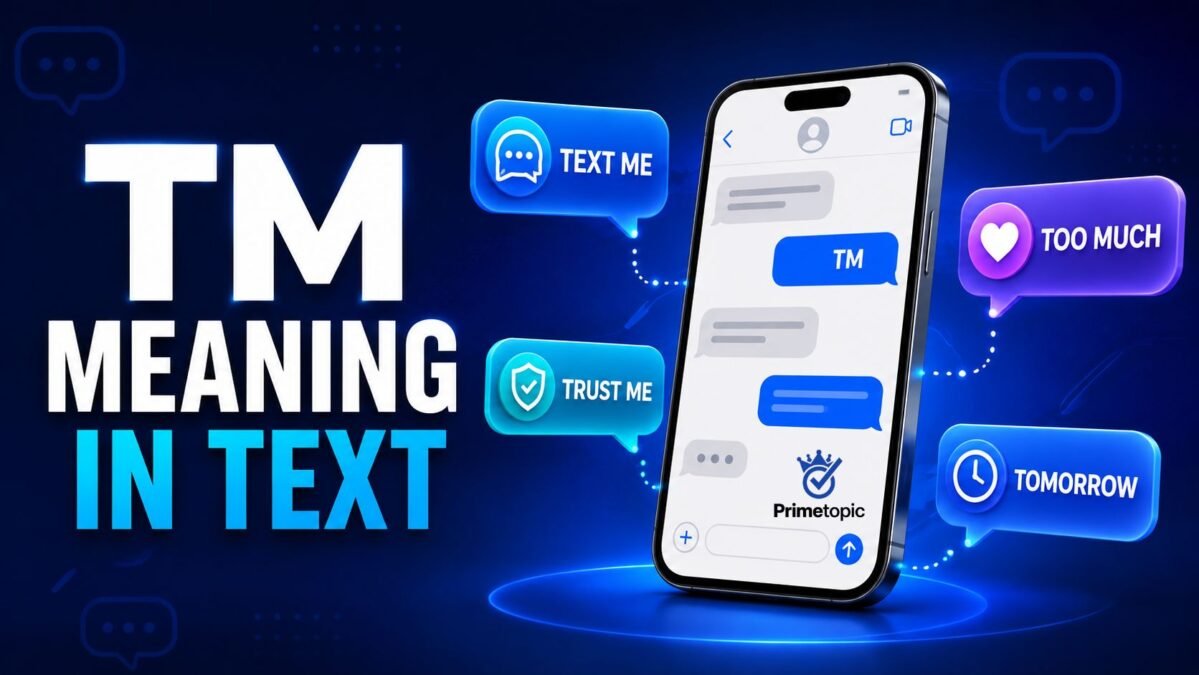

Short abbreviations can make online conversations faster, but they can also leave readers guessing. “TM” is a good example because it does not have one universal definition. The TM meaning in text depends on where the abbreviation appears, what the conversation is about, and how the sentence is structured.
In casual messages, TM may mean “text me,” “trust me,” “too much,” “tomorrow,” or occasionally “tell me.” In business-related writing, product names, and social media captions, TM usually refers to “trademark.” These meanings are not interchangeable, so context matters more than capitalization alone.
The simplest way to understand TM is to read the entire message rather than treating the two letters as a fixed slang term.
What Does TM Mean in Text Messages?
In an informal conversation, the most likely interpretations are “text me” and “trust me.” However, neither meaning is guaranteed. TM is less standardized than widely recognized abbreviations such as LOL, BRB, or IDK. Different social groups may use it differently, and some people may not recognize it as texting slang at all.
Consider these examples:
- “TM when you get home.”
Here, TM probably means “text me.” - “TM, you’ll love this restaurant.”
In this sentence, it most likely means “trust me.” - “That homework was TM.”
The intended meaning could be “too much.” - “Can we finish it tm?”
In a scheduling conversation, the sender may mean “tomorrow.”
Sentence position provides an important clue. When TM appears before a promise, prediction, or recommendation, “trust me” is usually a sensible interpretation. When it comes before a time condition such as “when you arrive,” it is more likely to mean “text me.”
Capitalization does not always solve the mystery. People frequently type messages in lowercase, omit punctuation, or use capital letters for emphasis. As a result, “tm” and “TM” may carry the same meaning in casual chat.
Common Meanings of TM at a Glance
| Meaning | Where it commonly appears | Example |
|---|---|---|
| Text me | Direct messages and personal conversations | “TM after the meeting.” |
| Trust me | Advice, reassurance, and recommendations | “TM, this method works better.” |
| Too much | Reactions and informal comments | “The drama was tm.” |
| Tomorrow | Plans and scheduling | “I’ll send it tm.” |
| Tell me | Questions or requests for information | “TM what happened.” |
| Text message | Discussions about communication | “I sent a TM earlier.” |
| Trademark | Business, branding, products, and captions | “They added TM beside the name.” |
Some of these uses are more natural than others. For example, many people would write “text” rather than TM when referring to a text message. Likewise, “tomorrow” is more commonly shortened to “tmr” or “tmrw.” Still, shortened forms develop within individual friend groups, workplaces, gaming communities, and online platforms, so unusual uses can appear.
TM as “Text Me”
“Text me” is one of the most practical interpretations when TM functions as an instruction. It usually appears on its own or before a phrase explaining when the recipient should make contact.
Examples include:
- “TM when you’re free.”
- “If the plan changes, TM.”
- “TM once you have the address.”
- “Don’t call because I’m working—just TM.”
Replacing TM with “text me” makes each sentence grammatically complete. That substitution test is a quick way to check the meaning.
Tone also matters. “TM” can sound brief and casual, making it more appropriate between friends than in formal communication. A message such as “Please text me when the documents are ready” is clearer in a professional setting.
TM as “Trust Me”
TM can also introduce reassurance or confidence. In this use, the sender is asking the other person to believe an opinion, prediction, or piece of advice.
For example:
- “TM, the second season gets better.”
- “You should leave early, TM.”
- “TM on this one.”
- “It looks difficult, but TM, you can handle it.”
Punctuation sometimes helps identify this meaning. A comma after TM often makes it read like “trust me,” although informal messages do not always follow normal punctuation rules.
The emotional tone may vary. “TM” can be sincere when someone offers reassurance, playful when recommending a show, or slightly dramatic when building suspense. The surrounding words reveal more than the abbreviation itself.
Can TM Mean “Too Much”?
“Yes, that’s TM” or “The whole situation was tm” may use the abbreviation to mean “too much.” This interpretation usually describes something excessive, overwhelming, unreasonable, embarrassing, or highly dramatic.
A person might write:
- “That outfit with all those accessories is tm.”
- “Three meetings before lunch is too much.”
- “Their argument was TM for me.”
This use is highly informal and may be limited to certain speakers or communities. “Too much” is also frequently written in full, so it is worth checking whether another interpretation makes more sense before assuming this definition.
When TM Means “Tomorrow”
Some senders use “tm” as a shortened form of “tomorrow,” especially in quick scheduling messages:
- “See you tm.”
- “Can we talk tm morning?”
- “I’ll finish the assignment tm.”
- “The package should arrive tm.”
The timing of the conversation usually makes this meaning obvious. If people are discussing a meeting, deadline, delivery, or future plan, “tomorrow” is a strong possibility.
However, TM is not the clearest abbreviation for tomorrow. Forms such as “tmr” and “tmrw” are easier to recognize. In an important conversation involving travel, work, money, or deadlines, writing the full word helps prevent misunderstandings.
What Does TM Mean on Instagram, TikTok, and Snapchat?
The meaning generally follows the same contextual rules across social platforms, but the format of the content can provide additional clues.
In a private Instagram or Snapchat message, “TM later” probably means “text me later.” In a TikTok comment such as “TM, you need to watch until the end,” it may mean “trust me.” A caption describing something as excessive could use “tm” for “too much.”
The situation changes when TM appears beside a brand name, slogan, catchphrase, or product. In that setting, it probably refers to a trademark rather than texting slang. People also use the ™ symbol humorously after an ordinary phrase to make it look like a signature expression:
“Professional Procrastinator™”
The person is not necessarily making a serious legal statement. The symbol may simply add irony, personality, or emphasis to the caption.
TM Versus the Trademark Symbol
TM written beside a company name or displayed as the raised symbol ™ stands for “trademark.” It signals that a person or business is claiming a word, logo, phrase, or other identifier as a mark connected with particular goods.
The ™ symbol does not automatically prove that the mark has been officially registered. In the United States, it can be used to indicate a trademark claim even without a federal registration. The registered trademark symbol, ®, has a different meaning and is generally reserved for marks that have completed the relevant registration process.
This distinction is especially useful when TM appears on:
- Product packaging
- Company websites
- Logos
- Advertisements
- App names
- Branded social media posts
Spacing and placement are strong clues. When TM or ™ sits immediately after a name—such as “ExampleBrand™”—it almost certainly refers to a trademark. When it appears as a separate word inside a private conversation, a slang interpretation is more likely.
Other Context-Specific Definitions
TM has several specialized meanings that rarely apply to everyday messaging. In medicine, it may be used as an abbreviation for terms such as transverse myelitis or tympanic membrane. In chemistry, Tm is the symbol for thulium. Pokémon games use TM for “Technical Machine,” an item associated with teaching moves.
These definitions demonstrate why context cannot be ignored. A gamer asking where to find a TM is probably not requesting a text message. Similarly, TM in a medical record should never be interpreted through ordinary internet slang.
If a message comes from a workplace, classroom, clinic, or specialized community, consider whether TM might be an established term within that field.
How to Work Out the Intended Meaning
Start by replacing TM with each possible definition and seeing which one produces a complete, sensible sentence.
“TM when you arrive” becomes “Text me when you arrive,” which sounds natural. “TM, this is the best option” becomes “Trust me, this is the best option.” In “Let’s meet tm,” only “tomorrow” fits comfortably.
The sender’s usual habits can be equally revealing. Friends often develop shortcuts that outsiders would not immediately understand. Someone may consistently use “tm” for tomorrow even though that usage is not universal.
When the consequences matter, asking is better than guessing. A short reply such as “Do you mean text me or tomorrow?” prevents confusion without making the conversation awkward.
Conclusion
The TM meaning in text is determined mainly by context. “Text me” and “trust me” are common possibilities, while “too much,” “tomorrow,” “tell me,” and “text message” may fit certain conversations. When TM appears next to a product, logo, or brand name, it usually means “trademark.”
Look at the sentence structure, subject, platform, and position of the abbreviation before choosing an interpretation. If several meanings still seem possible, asking the sender is the safest and clearest response.
FAQ
What does TM usually mean in a message?
It often means “text me” or “trust me.” The surrounding sentence determines which interpretation is more likely.
Can TM mean tomorrow?
Yes. Some people use “tm” as a shortened form of “tomorrow,” particularly while discussing plans or deadlines. However, “tmr” is often clearer.
What does TM mean after a name?
When TM or ™ appears immediately after a business, product, slogan, or brand name, it generally stands for “trademark.”
Is TM the same as LOL or BRB?
Not exactly. LOL and BRB have widely accepted meanings, while TM has several possible definitions and is more dependent on context.
What should I do if I cannot understand TM in a message?
Read the complete conversation and try substituting possible meanings. If the message remains unclear, ask the sender what they intended.
You May Also Read: Newsletter ShopNaclo: What Readers Should Know Before Subscribing