


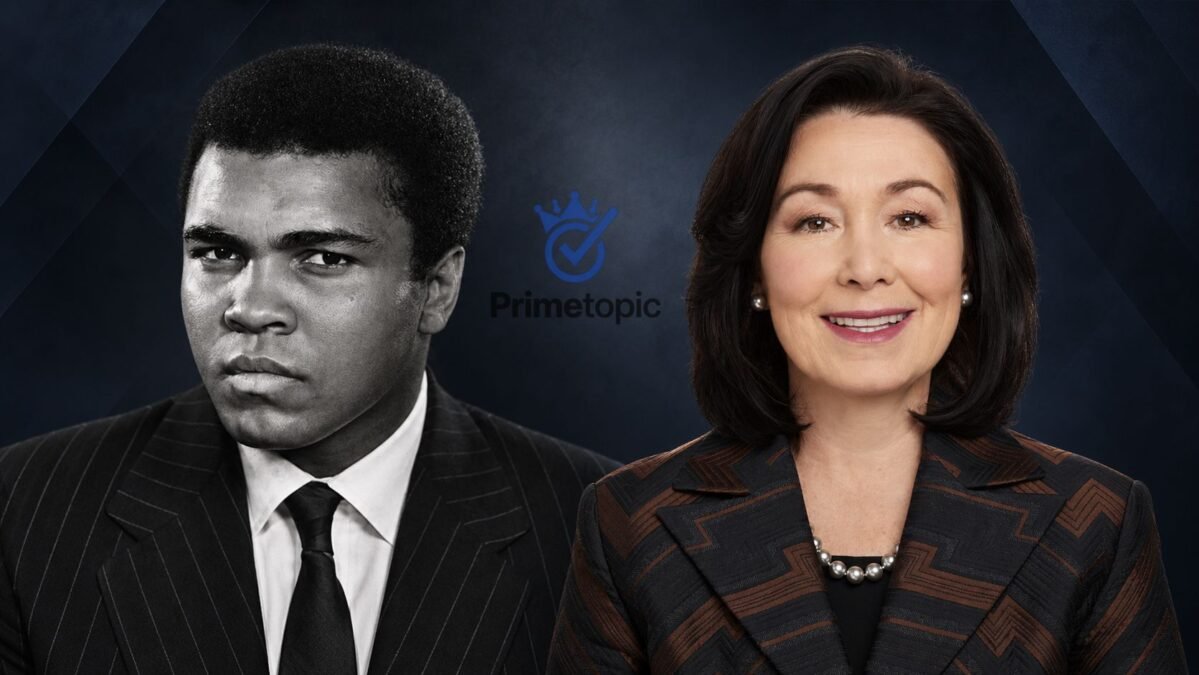
A search for Muhammad Ali and Safra Catz may suggest that the two public figures shared a personal, professional or family connection. The direct answer is that no reliable public record identifies such a relationship. Ali was an Olympic gold medallist, heavyweight boxing champion, activist and humanitarian. Catz is a business executive best known for leading Oracle.
Their careers belong to entirely different fields, and their names are most accurately understood as the subjects of a comparison rather than a documented partnership. Looking at their separate histories explains who they are, what each accomplished and why claims of a direct connection should be treated cautiously.
Are Muhammad Ali and Safra Catz related?
There is no credible evidence that Ali and Catz were relatives, spouses, business partners or collaborators. Authoritative accounts of Ali’s life do not place Catz within his sporting, political or humanitarian work. Likewise, official information about Catz’s career does not identify any association with Ali.
They also followed markedly different professional paths. Ali became internationally famous through boxing during the 1960s and remained a prominent public figure until his death in 2016. Catz built her career in investment banking and corporate management before becoming one of the most senior executives at Oracle.
A page or search result presenting their names together should therefore not be taken as proof of a relationship. Without reliable documentation of a meeting, joint project or personal association, the defensible conclusion is that they are two unrelated public figures.
Muhammad Ali’s career in boxing and public life
Muhammad Ali was born Cassius Marcellus Clay Jr. in Louisville, Kentucky, on January 17, 1942. He grew up while racial segregation remained legally enforced across much of the American South.
Ali began boxing as a child after his bicycle was stolen. Under the guidance of police officer and boxing coach Joe Martin, he developed into an accomplished amateur fighter. At 18, competing under his birth name, he won the light-heavyweight gold medal at the 1960 Olympic Games in Rome.
He then entered professional boxing and won his first 31 fights. His breakthrough came in February 1964, when he defeated Sonny Liston to become world heavyweight champion. Liston had been the strong favourite, making the result one of boxing’s defining upsets.
Shortly after that victory, the fighter announced his conversion to Islam and adopted the name Muhammad Ali. The change was central to his public identity, and he repeatedly insisted that journalists and opponents use his chosen name.
Ali’s importance extended beyond his performances in the ring. He opposed the Vietnam War and refused induction into the US armed forces on religious grounds. He was stripped of his heavyweight championship and prevented from boxing during several prime years of his career. After returning to competition, he regained the heavyweight title twice.
His later career included globally recognised contests against Joe Frazier and George Foreman. The 1974 victory over Foreman in Kinshasa, commonly known as the “Rumble in the Jungle,” restored Ali to the heavyweight championship and became one of his most famous sporting achievements.
The Muhammad Ali Center’s account of his life records both his boxing milestones and his wider work as an activist, diplomat and humanitarian. Ali and his wife, Lonnie, founded the centre in Louisville in 2005 to preserve his history and promote values including respect, conviction and social responsibility.
Ali lived with Parkinson’s disease during the later part of his life and helped raise public awareness of the condition. He died on June 3, 2016, aged 74. His legacy encompasses not only his three reigns as heavyweight champion but also his influence on discussions about race, religion, war and an athlete’s right to engage with political issues.
How Safra Catz built her career at Oracle
Safra Catz followed a route through education, finance and corporate management. She completed her undergraduate studies at the University of Pennsylvania’s Wharton School in 1983 and graduated from the university’s law school in 1986. Her status as a Wharton and Penn Law alumna is confirmed in the university’s profile of Catz as a 2018 graduation speaker.
Before joining Oracle, Catz worked in investment banking at Donaldson, Lufkin & Jenrette, where she held senior positions and covered the technology sector. That experience provided the financial and transactional background that would define much of her later work.
Catz joined Oracle in 1999 as a senior vice president. She became a member of its board of directors in 2001 and served in a succession of senior posts, including president and chief financial officer.
In September 2014, Oracle founder Larry Ellison stepped away from the chief executive position, and the company appointed Catz and Mark Hurd as CEOs. Catz subsequently became Oracle’s sole CEO following Hurd’s death in 2019.
Her responsibilities were concentrated on Oracle’s operations, finances and corporate strategy rather than its day-to-day product engineering. She also became closely associated with the company’s expansion through acquisitions and its transition from a business dominated by traditional database software to one increasingly focused on cloud infrastructure and applications.
Catz remained CEO until September 2025. In Oracle’s official leadership announcement, the company appointed Clay Magouyrk and Mike Sicilia as CEOs and moved Catz into the role of executive vice chair of its board. She therefore remains involved in Oracle’s leadership, although she is no longer its chief executive.
Two very different forms of public influence
The contrast between the two figures is clearer when their verified careers are placed side by side.
| Area | Muhammad Ali | Safra Catz |
|---|---|---|
| Primary profession | Professional boxer | Business executive |
| Main field | Sport, activism and humanitarian work | Technology, finance and corporate management |
| Defining achievement | Olympic gold and three heavyweight championship reigns | Senior leadership at Oracle, including 11 years as CEO |
| Public role | Athlete who spoke openly about race, religion and war | Executive responsible for major operational and financial decisions |
| Current status | Died in 2016 | Executive vice chair of Oracle’s board |
Both achieved international recognition, but the nature of that recognition was different. Ali’s influence was highly public: it came through athletic competition, speeches, interviews, religious conviction and political protest. Catz’s influence developed primarily inside a major technology company through financial oversight, acquisitions, operations and long-term corporate strategy.
Ali’s career also unfolded in front of mass audiences. His victories, defeats and political decisions became international news. Catz has occupied an influential but less celebrity-driven position, working within corporate leadership structures and communicating mainly with investors, employees and business customers.
These distinctions matter because combining two famous names can create a misleading impression of shared history. Public prominence alone does not establish a personal or professional association.
The accurate takeaway
The verified record does not show a direct connection between Muhammad Ali and Safra Catz. Ali’s life centred on boxing, civil rights, religious conviction and humanitarian activity, while Catz’s career has centred on finance, technology and Oracle’s corporate development.
Both became influential in their respective arenas, but their achievements should be understood independently. Describing them as relatives, partners or collaborators would go beyond the available evidence.
You May Also Read About: Roger Federer and Conor McGregor: How Two Athletes Built Worldwide Fame