
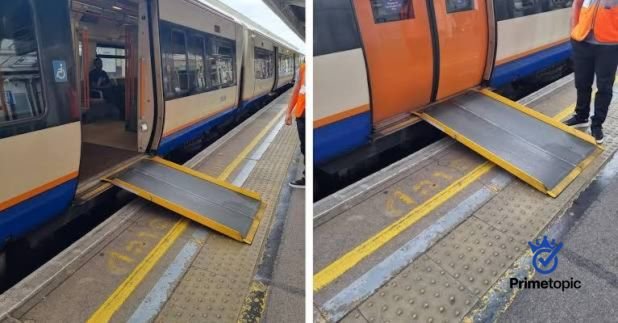

The London Overground ramp safety report explains how a train left Norwood Junction station with a portable boarding ramp still attached. Published by the Rail Accident Investigation Branch (RAIB) on 22 June 2026, Report 09/2026 examines the incident of 1 July 2025. Nobody was injured, but the ramp travelled along the platform before striking a barrier. Investigators identified an unsuitable ramp, ineffective departure checks and problems with staff warnings reaching the driver. Six recommendations address ramp management, staff competence, technical requirements and distraction from mobile devices.
For passengers, the report concerns the equipment and procedures that make assisted boarding safe, particularly when a train is preparing to depart.
What Happened at Norwood Junction?
At approximately 09:52 on 1 July 2025, a London Overground train departed Norwood Junction on the Windrush line while a portable access ramp remained attached to a doorway.
Platform staff had positioned the ramp to help a passenger using a mobility scooter board the train. Nobody was on the ramp when the train began moving. However, it remained connected and was dragged along the platform, creating a hazard for people nearby.
The ramp eventually struck the barrier at the platform’s end and fell beside the track. It was damaged beyond repair, while the train sustained minor damage. Staff and a passenger took action to avoid the moving ramp.
Arriva Rail London operated the service at the time. The final report directs its operator-specific recommendations to First Rail London, which took over the London Overground concession on 3 May 2026.
Why the Ramp Did Not Prevent Departure
The central equipment problem was compatibility. Staff were using the wrong type of portable ramp for the Class 378 train involved.
Portable boarding ramps are designed for particular trains because door mechanisms and boarding heights vary. At Norwood Junction, different train types required different ramps. Equipment that could attach to a doorway was therefore not necessarily suitable for that train.
The correct Class 378 ramp has extended arms that prevent the doors from closing while it is in position. This works alongside the train’s door interlock: the safety system that checks whether doors are closed and locked before allowing traction power.
With the incorrect ramp attached, the doors could close and the train could obtain power. The equipment therefore failed to provide the protection expected from the correct ramp.
RAIB found that the appropriate ramp had been unavailable since September 2021. Station checks had not identified its absence, and platform staff did not realise that the replacement equipment was unsuitable for the train.
London Overground Ramp Safety Report: Departure Checks
The investigation also examined why the departure process did not detect the attached ramp.
RAIB found that the driver believed it was safe to leave, but their safety checks were ineffective. Investigators concluded that distraction from a mobile phone call was probably responsible, while acknowledging that other factors might also have been present.
That qualification matters: the report identifies a probable explanation rather than claiming certainty about every influence on the driver’s attention.
Platform staff tried to stop the departure. However, their warning signals were outside the cropped view shown on the driver’s in-cab monitor. The attempted intervention therefore did not reach the driver through the displayed camera images.
The operator’s instructions required visual checks as well as confirmation from the door interlock. Drivers were specifically warned against relying on the interlock indicator alone to establish that the doors were unobstructed. In this incident, closed doors did not establish that the platform area was clear of equipment attached to the train.
The Six Safety Recommendations
The London Overground ramp safety report sets out six recommendations covering both local operating arrangements and wider railway practice.
| Responsible organisation | Recommended action |
|---|---|
| First Rail London | Review ramp risk assessments and management processes, including checks that compatible ramps are available for the trains serving each station. |
| First Rail London | Review driver competence and station staff training, covering initial instruction, ongoing training and assessment. |
| Department for Transport | Consider an explicit technical requirement preventing doors from closing, or traction power being obtained, with a portable ramp attached. |
| Rail Safety and Standards Board | Review train dispatch standards to address the risk of departure with an attached ramp and the measures needed to prevent it. |
| Rail Safety and Standards Board | Review education, guidance and training about inappropriate mobile-device use by drivers. |
| Office of Rail and Road | Review whether operators adequately identify, assess and control distraction risks from drivers’ inappropriate use of mobile devices. |
The first two recommendations call for plans with defined timescales to implement the changes identified through those reviews.
RAIB also highlighted two learning points: staff in safety-critical roles should recognise when personal issues may affect their work and seek appropriate support, while drivers must understand the distraction risks of mobile-phone use outside situations permitted by operating rules.
Actions Recorded After the Incident
The report records measures that had already been taken or were in progress when it was prepared.
Arriva Rail London audited portable ramps at stations served by London Overground trains to check that the correct equipment was available. Where stations held several ramp types, labels identified the train classes each ramp could serve. Ramps unsuitable for Class 378 trains also received warning tags.
The operator provided refresher material for drivers and additional training for platform staff at stations using multiple ramp types. This information also reached relevant stations managed by other operators.
A new risk assessment addressed ramp fitting and use, including more frequent staff training and improved maintenance arrangements. The operator also reported work with the manufacturer on proactive maintenance and inspections.
These are recorded actions and work in progress. They should not be read as confirmation that every recommendation had been completed.
What Passengers Should Know About Boarding Assistance
TfL continues to provide boarding ramps to help passengers cross larger steps and gaps between platforms and trains. Staff deploy the equipment; passengers can request assistance from a staff member or through the information button on a station help point.
A useful distinction when planning a journey is the difference between two accessibility descriptions:
- Step-free from street to platform: the route avoids stairs, but a boarding ramp may still be necessary to reach the train.
- Step-free from street to train: the remaining step or gap is small enough for most wheelchair users to board, although some passengers may still need assistance.
TfL’s maps distinguish these arrangements using white and blue wheelchair symbols respectively. Mini ramps bridge smaller remaining gaps at selected locations, including the Windrush line platforms at Whitechapel.
Passengers should make themselves known to station staff on arrival. Under TfL’s turn-up-and-go arrangements, staff can organise boarding support and assistance at interchange and destination stations.
Where a ramp is needed to leave the train, TfL says departure-station staff will contact the receiving station so someone can meet the passenger. Its journey-planning tools also allow users to select step-free access from street to train.
Understanding the Report’s Scope
The London Overground ramp safety report investigates a specific dangerous occurrence and the weaknesses that allowed it to happen. Its findings do not establish that every ramp or every assisted journey across the network is unsafe.
RAIB’s role is to prevent future accidents and improve railway safety. It does not determine blame or liability, or conduct prosecutions.
The documented failures concern several connected safeguards: selecting compatible equipment, checking its availability, maintaining staff competence, observing the platform and controlling distraction. The recommendations address those responsibilities while TfL’s passenger guidance continues to direct people towards staff-assisted boarding.
You May Also Read About: Palmer Luckey and Jeff Greene: Are They Related?